


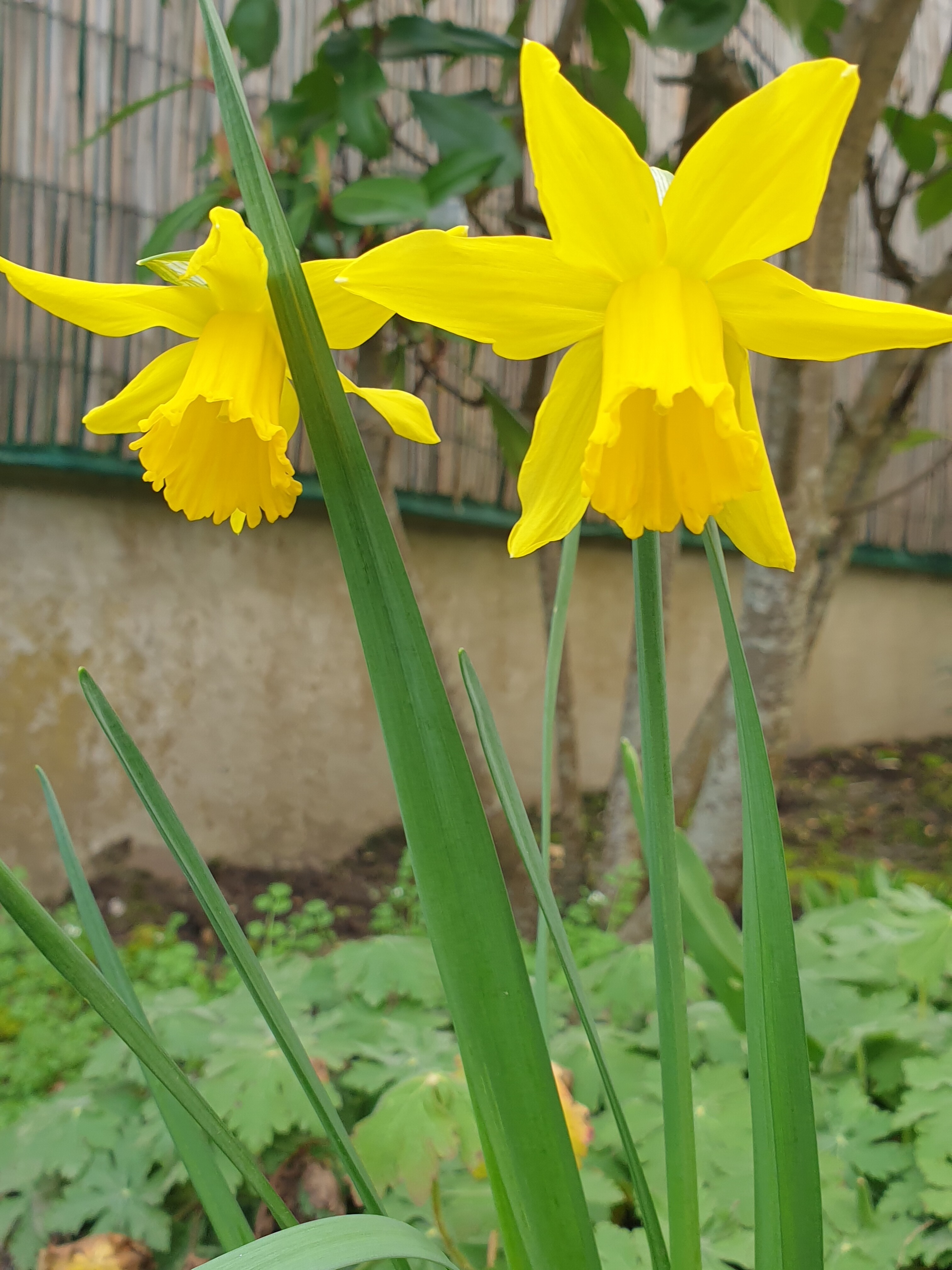
Thanks to the former house owner, I am now enjoying the flowers of her labour. It’s our first spring garden in France, in the house that we bought last July. We only moved into the house in July. As a result, we have never had the chance to get acquainted with the flowers planted in this 300m² garden. I am looking forward to this spring of pretty surprises. We’ll get to discover the different types of plants the previous lady of the house had planted.
The weather has been rather unstable since the end of January. At times, it ranges from mid-single digits at night to sunny low teens — up to 14°C — in the daytime. Other times — like the past few days — it ranges from -2°C at night to a greyish 10°C in the daytime. The occasional overnight frost makes one hesitate to say that the spring is here. Nevertheless, we know that spring is ALMOST here. We can tell from the visual delights sprinkled around our spring garden in France.
Towards the end of January, I noticed clumps of long, narrow, flat, basal green leaves sprouting out of the soil. The clumps spread mainly along the garden paths. Then, I noted the emergence of slim, pale yellow flower buds, each one on a stem. It was only two weeks ago that the plant came into full bloom. Bright yellow six-petalled flowers unfurled, each with a trumpet-shaped corona. By using PictureThis, an app that identifies the plant type, I managed to identify the flower. People call it the trumpet or common daffodil (Fr: Narcisse jaune ou Narcisse trompette).
It was only then that I noticed that the common daffodil is indeed VERY COMMON. Perhaps it’s because I can now recognise the flower and have it in my garden, so I see it everywhere. For instance, I only noticed the row of bright yellow common daffodils planted near the city centre yesterday. We spotted them on our drive to the supermarket.
The snowdrops caught my attention one day, around the time when the common daffodils started blooming. I am using “caught my attention” because the little pure-white bells seemed to just appear overnight. They were not there one day, and then they emerged out of nowhere the following day! Of course, like the common daffodils, the snowdrops’ leaves and stems must have appeared a few weeks before. However, due to their short stature (about 10 cm) compared to the 30 cm of common daffodils, we simply overlooked them.
Another early spring flower is the primrose (Fr: primevère acaule). Most of the primroses that are in the garden are the purple ones: five purple petals with orange-yellow centres. These low-growing flowers (about 5 cm tall) have crinkly green leaves, and they spread widely around the garden. In fact, they even show up where they shouldn’t: in the cracks between the paving stones of the garden walkway. The other colour of primrose that we have is white—white petals with orange-yellow centres. As of now, there is only a handful in bloom.
The last flower on the list of early spring arrivals in the garden is the yellow crocus (Fr: crocus jaune). It’s a low-growing plant with goblet-shaped flowers. So far, we have only seen a handful of yellow crocus lying around. We have also spotted a purplish crocus, standing upright and tall by itself; the French call it crocus de naples. Perhaps we will see more of this plant as the weather warms up.
I have restarted doing my rounds of our spring garden in France. This is a task I will look forward to doing every day.
When we first moved into the house, I would do that every morning when I did not have to work. This was during the summer and the fall. I would go once or twice around the garden. I’d pick up fallen hazelnuts and apples, then check on the tomatoes and lettuces. At the same time, I made sure that no plants were dying under my watch. I also made sure I hadn’t missed any new ones popping out overnight. The rounds stopped when winter arrived. I had to leave the house before sunrise, and often the sun had already set by the time I returned.