
A Blister-Pack Mooncake in Grenoble
My husband and I had just finished eating the second half of the mooncake. We ate it a day later than the official day of the Mid-Autumn festival (中秋节), which fell on the 25th of September this year. The date changes every Gregorian calendar year since the festival follows the lunar calendar, and it falls on the 15th of the eighth month. We had eaten the first half earlier in the week, right after I bought it from the local Asian grocery store in Grenoble.


The grocery store had carelessly displayed the mooncakes on a shelf, with other sundry food items. There were no customary Mid-Autumn festival decorations. Nor did anyone pay special attention to the presentation of these festive snacks. Each of these square mooncakes sat in a commonplace plastic blister pack inside a pillow pack. They were inexpensive, costing just a couple of euros each. I had no expectations about the quality. I was just glad that the grocery store sold them and I bought one.

It was a traditional baked mooncake filled with white lotus paste with two salted duck yolks embedded (双黄白莲蓉月饼). If they had mooncakes with four yolks, I would have certainly bought them. I love salted duck yolks. When I was young, I would often eat them as a side dish with porridge. Back home in Singapore, mum would always splurge on mooncakes with four egg yolks.
I can’t recall the last time I celebrated Mid-Autumn festival with my parents. Since the festival always falls between mid-September and early October in the Gregorian calendar, it coincides with La Rentrée in France. La Rentrée is when the school year starts. It would be impossible for me to take a few days off to fly back to Singapore for the mooncakes.
Legends of the Moon
Growing up in Singapore, Mid-Autumn festival meant mostly indulging in the sweet desserts and having fun as kids carrying lanterns around the neighbourhood. I don’t recall being taught the origins of the festival which can be traced back as far as 3,000 years ago during the Zhou Dynasty.
Still, there were various myths surrounding the festival. One version was about Chang’e, a beautiful woman and her husband, the archer Hou Yi. The latter saved the earth from drought by shooting down nine of the ten suns. The people then crowned him king for accomplishing the feat. However, Hou Yi became a tyrant after becoming king, and he somehow managed to obtain an elixir of immortality.
To stop her husband from being immortal which would mean the people would suffer his despotic rule forever, Chang’e decided to prevent Hou Yi from consuming the elixir. It was on the 15th day of the 8th lunar month that Chang’e ate the elixir herself while Hou Yi was sleeping. It seemed that the elixir made Chang’e weightless, and she started drifting upward into the sky. When Hou Yi discovered the theft, he shot arrows at his wife who managed to escape and float to the moon. When the villagers learned of Chang’e’s sacrifice, they laid out offerings which included round pastries—mooncakes.
Pastries of Rebellion
There was also a folk legend related to the festival. It claimed that the Han Chinese in the Yuan Dynasty (right after the Song Dynasty) used mooncakes in their uprising against the Mongols, the nomadic conquerors who defeated the Song Dynasty. Under the Mongol rule, Han Chinese could not gather in big groups or freely own weapons (a few families shared one kitchen knife). To coordinate the rebellion, the Han Chinese hid secret messages in desserts—mooncakes. The messages instructed the populace to kill the Mongol rulers on the 15th day of the 8th lunar month.
Circles of Reunion
Whether it was born out of lunar sacrifices or rebellion, traditional mooncakes are usually baked round to symbolise the fullness and completeness of the full harvest moon. In Chinese, the word for round 圆 (yuan) also forms part of the word for reunion 团圆 (tuan yuan). The roundness of the mooncake represents the families’ wish to have all their loved ones with them during this special moment, that is, a reunion.
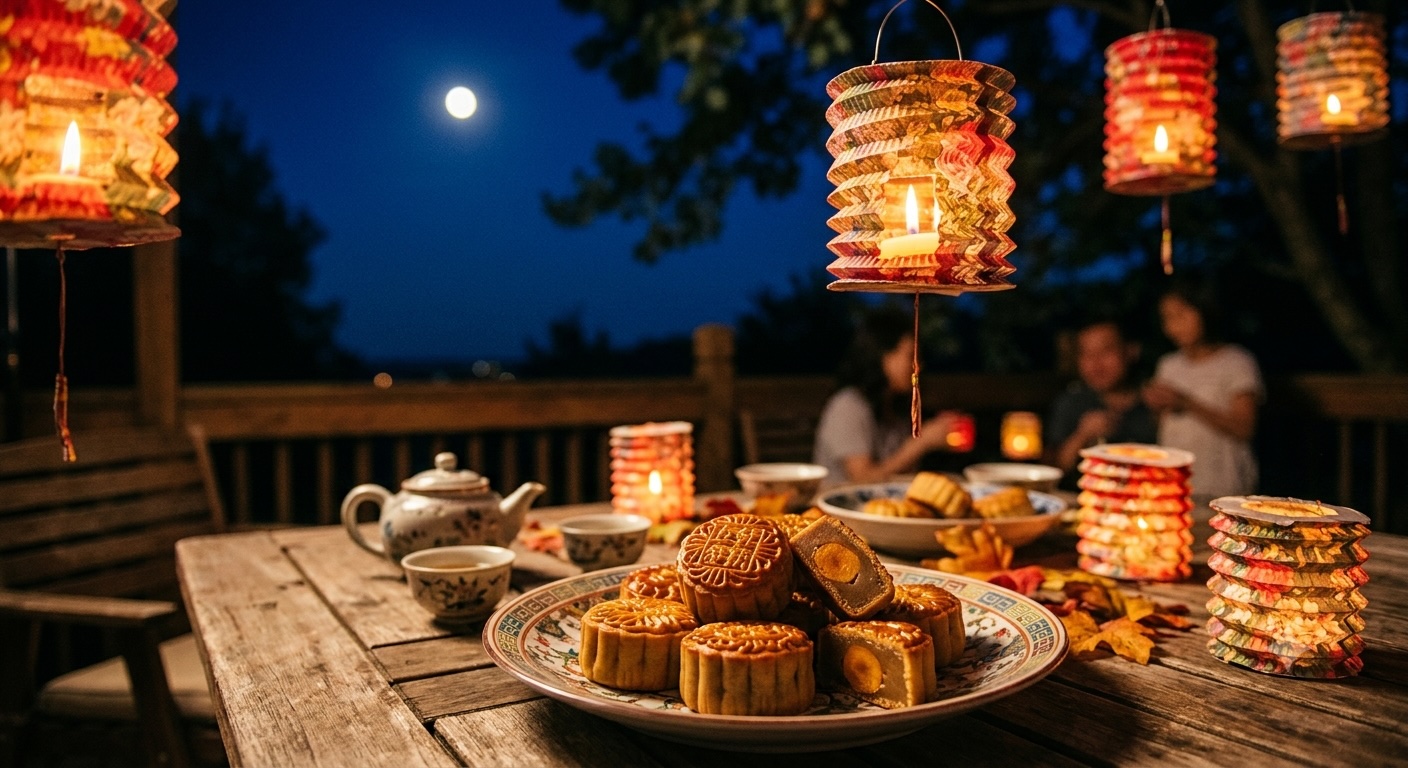
Mid-Autumn Festival is not a public holiday in Singapore. Yet, many Chinese families still find time out of their hectic lives to meet for dinner, followed by mooncake sharing. As the filling of traditional mooncakes is dense and sweet, it would be too heavy for a person to eat the entire mooncake. Instead, families usually cut a mooncake into quarters, and everyone takes a wedge. It is also a custom to drink Chinese tea while eating mooncakes. The mildness of the tea balances the sweetness of the mooncake.

I like eating the traditional mooncakes, but they are a tad sweet for my taste and heavy in calories. For those like me who occasionally prefer something lighter on the palate, the alternative is snow skin mooncakes, the modern version of the round pastries.
Unlike the baked golden-brown pastry crust of traditional mooncakes, which usually requires large amounts of syrup and oil, the exterior of snow skin mooncakes is unbaked and made from glutinous rice, giving them an icy, snow-like look. They come in pastel colours and often contain less-sweet fillings such as fruits or green tea. Served cold, these soft colour alternatives are much easier to digest after a heavy family dinner.
The Corporate Mooncake Run
In Singapore, it’s also a corporate tradition to give mooncakes to clients to build strong business relationships. I can still remember the times when I had to visit clients at their premises with boxes of mooncakes two to three weeks before Mid-Autumn Festival. For a business development executive in the financial industry, the festival was a good opportunity to touch base with clients.
Prior to the visits, I would draw up a list of important clients to visit and then call them up for appointments. I would pair up with a colleague to do the mooncake rounds together for a few days consecutively. The most efficient way for us to do our job was to use the company’s delivery van to do our rounds in the financial district of Singapore. In our business suits and heels, we would load boxes of mooncakes into the back of the van. My colleague would take the front seat, while I, being the junior, had to scramble awkwardly into the back of the van.
We had planned our visits such that the offices of clients for each round were located close to each other. The driver would first drop us off at a secluded corner with several boxes of mooncakes. Then, instead of lugging all the mooncakes to the office of every client, one of us would take a box and visit a client, while the other stood guard over the remaining mooncakes. If any passersby had come across us, they would have seen two harried-looking well-dressed female professionals, each with a workbag slung over a shoulder and a luxurious-looking gift bag with the logo of some premium mooncake in each hand, clicking purposefully back-and-forth from a corner.
Candles, Wire, and Cellophane
While mooncakes were the way to unlock clients’ goodwill, lanterns were the key to delighting children. As kids, my siblings, cousins and I would each carry a lit lantern and walk around the estate, meeting other kids. It felt reminiscent of older times, when the villagers carried lanterns to light their path as they strolled in the dark, beneath the glow of the harvest moon to attend the various festive events.
I remember my first lanterns were made with colourful cellophane modelled with wire framing and lit by candles. These lanterns usually came in shapes of the 12 Chinese zodiac animals. The soft glow from the candles created a magical atmosphere for the evening, making the rounds around the estate more like an adventure.
I had even tried to make my own lanterns using wire and cellophane. The lanterns were usually cylindrical as that was the easiest shape to construct. The tricky part was to make the wire coil that held the candle. The coil had to be light yet strong, and of the exact size to hold the candle upright. If not, the candle could just fall right through, or worse, fall sideways and burn the lantern!
To avoid fire hazard, classic lanterns have been gradually replaced by battery-run plastic lanterns that often play repetitive, loud melodies. Safety is certainly the priority, yet the use of battery-run lanterns seems, in my opinion, to make the lantern stroll tacky.
Caged Piglets
Another nostalgic treat is Piglet in the Cage biscuit (猪笼饼). The golden-brown biscuits are shaped like piglets and are sold in colourful plastic cages. They are made from the same dough as the traditional mooncakes, but chewier and denser, and don’t come with filling. These cute snacks are a hit with children.

The history dates back to the 1930s and 40s in Guangzhou, China. It seems that mooncake bakers used the leftover bits of the traditional mooncake dough to make these biscuits. Or perhaps it was that the bakers used pieces of dough to test the temperature of the oven. Regardless of the reason, the bakers eventually moulded these samples into piglets and packed them in bamboo or plastic cages. They carried the symbolic meaning in Cantonese of ‘a pig cage entering the water’ (猪笼入水), which idiomatically means ‘financial wealth pours in from everywhere.’
A Mooncake to Fill the Void
As expected, the mooncake didn’t taste as good as those back home. Admittedly, the mid-to-high-end mooncakes I grew up with in Singapore had spoilt me. In Singapore, people usually buy mooncakes in boxes of four. A month before the festival, supermarkets, bakeries and hotels start selling them. Prices range from S$20 (€14) to more than S$300 (€210) per box, for luxury hotel collector’s editions.
The mooncake tasted just like a mooncake with its crust, paste and egg yolks. Yet, the crust was not as soft-chewy, not as tender. The paste was not as rich, as fragrant. The egg yolk not as savoury, as silky. But it served its purpose. It filled part of the nostalgic void. And shared with my husband, it was our own little reunion, far from home.